


Hair Loss
Alopecia Areata: Symptoms, Causes and Treatment
Learn what alopecia areata is, recognize common symptoms, understand possible triggers, and explore treatment options and when to seek medical advice.
Published on Oct 23, 2026

Vérifiez l'orthographe ou essayez une autre recherche. Vous pouvez également parcourir nos traitements ou rechercher le prix des médicaments.
AI summaries may be inaccurate. Always confirm health information with a healthcare provider. Third-party AI tools are not operated by PocketPills.
Seborrheic dermatitis is a common skin condition that causes flaking, itching, and inflammation, particularly on the scalp. Although it does not typically cause permanent hair loss, persistent irritation and scratching may contribute to hair breakage or temporary shedding.
Seborrheic dermatitis is a common skin condition that causes flaking, itching, and inflammation, particularly on the scalp. Although it does not typically cause permanent hair loss, persistent irritation and scratching may contribute to hair breakage or temporary shedding. Understanding the connection can help you recognize symptoms, care for your scalp, and know when to seek professional advice.
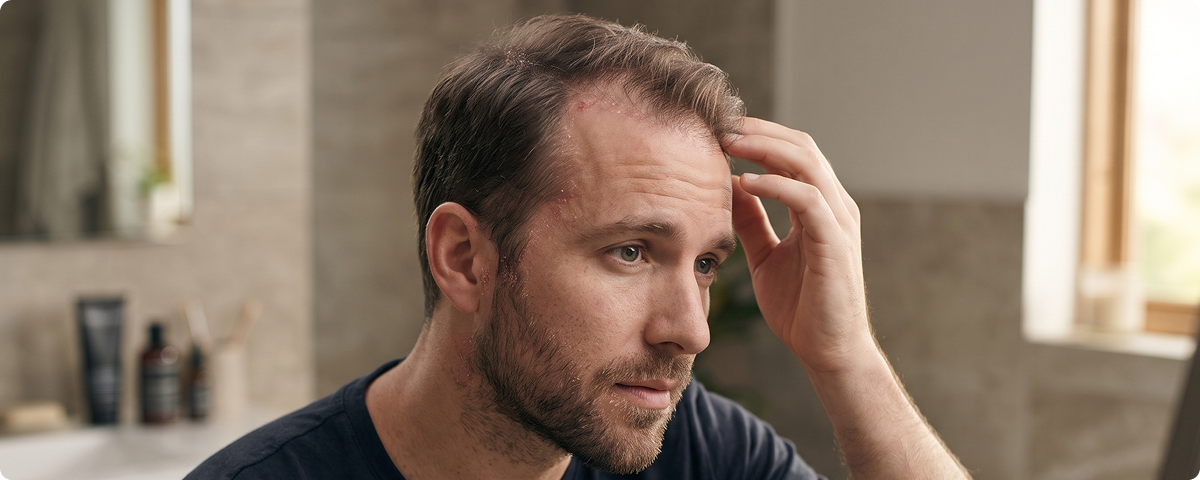
An itchy scalp covered in flakes can be frustrating enough on its own. But when you also notice more hair falling out than usual, it's natural to wonder whether the two problems are connected.
Seborrheic dermatitis is one possible explanation for the scalp symptoms. It can cause persistent flaking, itching, and inflammation, ranging from mild dandruff to more noticeable patches of irritated skin.
The relationship between seborrheic dermatitis and hair loss is not always straightforward. The condition does not usually destroy hair follicles, but scratching, irritation, and other underlying scalp problems may complicate the scenario. Understanding what is happening can help you decide what to do next.
Seborrheic dermatitis is a common, recurring skin condition that affects areas rich in oil-producing glands, including the scalp, eyebrows, sides of the nose, and behind the ears.
On the scalp, it can cause:
The Canadian Dermatology Association's guide to dandruff explains that dandruff is often associated with seborrheic dermatitis, although other scalp conditions can produce similar symptoms.
The exact cause of seborrheic dermatitis is not fully understood. Factors involving naturally occurring skin yeast, oil production, and individual susceptibility may contribute. It is not a sign of poor hygiene, and it is not contagious.
The condition can improve and flare up again, so managing symptoms may involve ongoing scalp care.
Seborrheic dermatitis does not usually cause permanent hair loss. However, scalp irritation and scratching may contribute to hair breakage or temporary shedding in some circumstances.
There are several reasons you might notice more hair falling out while experiencing scalp symptoms.
Persistent itching can make you scratch your scalp repeatedly. Vigorous scratching may damage the hair shafts, causing strands to break and making your hair appear thinner.
Scratching can also injure the skin, worsen irritation, and increase the risk of secondary infection.
Avoiding repeated scratching and addressing the underlying itch may help reduce additional damage.
Seborrheic dermatitis can cause inflammation and scaling. When symptoms are persistent or severe, the discomfort may affect how you wash, brush, and care for your hair.
Some people notice increased shedding alongside an irritated scalp. However, this does not automatically mean seborrheic dermatitis is responsible for the hair loss. Other causes may be present at the same time.
An itchy, flaky scalp and hair loss can occur together for reasons other than seborrheic dermatitis.
For example, scalp psoriasis, fungal infections, certain forms of inflammatory hair loss, and other medical conditions may cause overlapping symptoms. Stress, hormonal changes, nutritional deficiencies, and hereditary hair loss can also contribute to shedding independently of scalp irritation.
The HealthLink BC guide to scalp problems discusses several possible causes of itching, flaking, and hair loss.
If shedding is substantial, continues despite improving scalp symptoms, or occurs in distinct bald patches, it is worth seeking an assessment rather than assuming dandruff is the cause.
The pattern of hair loss can provide clues, although appearance alone cannot confirm the cause.
You might notice:
Seborrheic dermatitis alone does not typically produce smooth, clearly defined bald patches. If you develop these, or notice progressive thinning, pain, or areas that appear scarred, seek professional advice.
Several scalp conditions can cause itching and flakes, so it is important not to rely on symptoms alone.
These conditions can overlap, and some people have more than one scalp condition at a time. A healthcare practitioner can examine your scalp and determine whether further investigation is needed.
The right approach depends on how severe your symptoms are, which areas are affected, and whether another condition is contributing.
Anti-dandruff shampoos and other scalp-care products may help manage flaking and itching associated with seborrheic dermatitis.
Follow the instructions for the product you choose, including how frequently to use it and how long to leave it on the scalp. Different products have different instructions and may not be suitable for everyone.
If your symptoms persist, worsen, or return frequently, a pharmacist or healthcare practitioner can help you determine whether a different approach is needed.
Scratching may worsen irritation and damage fragile hair. Try to handle your hair gently, avoid picking at scales, and reduce styling practices that pull tightly on the scalp.
Excessive heat and harsh chemical treatments can also contribute to hair breakage, particularly when your hair is already fragile.
Seborrheic dermatitis can flare up repeatedly, even after symptoms improve. Keeping track of what seems to worsen your symptoms and following appropriate scalp-care instructions may help you manage recurrences.
If over-the-counter products are not helping, professional assessment can clarify whether you need additional care or whether another diagnosis should be considered.
If you continue losing hair after the itching and flaking improve, do not assume the shedding is simply part of seborrheic dermatitis.
A practitioner may ask about your health history, recent illnesses, stress, nutrition, medications, and the timing of your hair loss. Depending on the findings, they may recommend additional tests or specialist assessment.
Treating scalp irritation may improve comfort, but it will not necessarily address a separate cause of hair loss.
If the hair loss is related to temporary breakage or shedding and the hair follicles remain healthy, improvement may be possible once the scalp problem is under control.
However, regrowth depends on the actual cause of the hair loss. If another condition is contributing, the appropriate management may be different.
Hair also grows slowly, so changes in density may take months to become noticeable. If hair loss continues, worsens, or leaves persistent bald areas, seek professional advice instead of waiting indefinitely for regrowth.
Consider speaking with a healthcare practitioner if you experience:
These symptoms may indicate an infection, another scalp condition, or a separate cause of hair loss. Early assessment is particularly important when there are signs of inflammation or possible scarring.
If you're concerned about hair shedding, identifying the cause is an important first step.
Pocketpills offers an online hair loss treatment service for eligible Canadians. You can explore the hair loss treatment service and its assessment process to learn about the next steps available to you.
A licensed Canadian practitioner can review the information you provide and determine whether further assessment or treatment may be appropriate. If a prescription is clinically appropriate and you meet the service's eligibility requirements, it may be prescribed and dispensed through Pocketpills’ pharmacy.
Seborrheic dermatitis does not typically cause permanent hair loss. However, severe irritation, scratching, or another underlying scalp condition may contribute to hair damage or shedding. Persistent hair loss should be assessed.
An itchy scalp does not automatically mean you will lose your hair. However, repeated scratching can damage hair shafts and irritate the skin. The underlying cause of the itching may also need treatment.
Managing the condition may reduce itching, flaking, and irritation. If temporary shedding or breakage is related to the scalp problem, improvement may follow. Regrowth is not guaranteed, especially if another cause of hair loss is present.
They are closely related but not identical in every case. Dandruff generally involves flaking and itching, while seborrheic dermatitis may cause more noticeable inflammation and can affect areas beyond the scalp.
Seek professional advice if hair loss is sudden, substantial, persistent, or accompanied by bald patches, scalp pain, sores, or significant inflammation. These symptoms may suggest something beyond uncomplicated dandruff.
Seborrheic dermatitis can cause an itchy, flaky, irritated scalp, but it does not usually cause permanent hair loss. Scratching and hair breakage may contribute to changes in hair appearance, while ongoing shedding may have another underlying cause.
Managing scalp symptoms and avoiding unnecessary hair damage are useful first steps. If hair loss continues or your scalp becomes painful, inflamed, or develops bald patches, seek professional advice to understand what is happening and which next steps may be appropriate.
More reads from Weight Loss.
Rejoignez des millions de Canadiens qui ne font plus jamais la queue.